A founder I coached had a CFO he kept describing as "too cautious." She was always raising risks, modeling downside scenarios, asking what could go wrong. He saw it as drag.
So he started bypassing her — pushing decisions directly to his head of growth, who said yes faster. A year later, two of those decisions had blown up in ways the CFO had warned about. She wasn't being cautious. She was prevention-focused. And he'd been ignoring exactly the part of his team that kept him out of trouble.
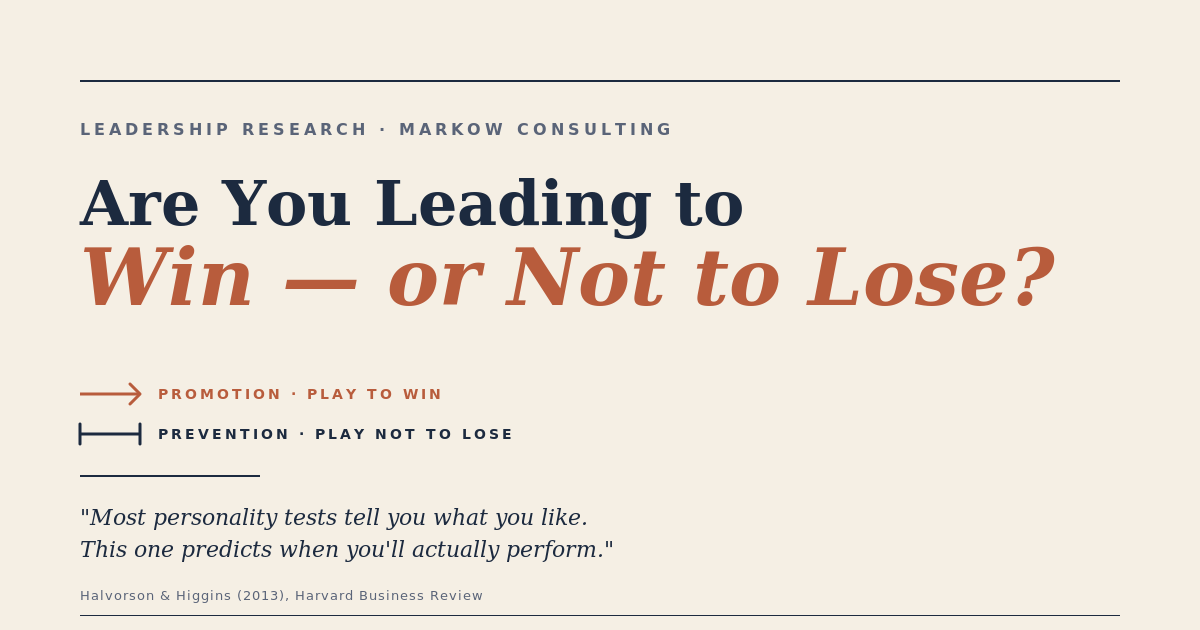
This is the core insight from Heidi Grant Halvorson and E. Tory Higgins's research on motivational focus, summarized in their Harvard Business Review article (2013). Most personality tools — Myers-Briggs, DiSC, Enneagram — describe what people like to do. Halvorson and Higgins's framework is rarer. It predicts performance.
There are two types.
Promotion-Focused
Sees goals as paths to gain. Concentrates on rewards. Comfortable with risk. Works fast, dreams big, thinks creatively. Makes great pitchmen, founders, growth leaders. Also makes more errors and skips Plan B.
Prevention-Focused
Sees goals as responsibilities. Concentrates on what could go wrong. Risk-averse, vigilant, thorough. Works meticulously to protect what's been built. Makes great CFOs, COOs, and ops leaders. Generates fewer creative ideas.
Most leaders have a dominant focus. Most teams need both.
The work doesn't fail because someone is wrong. It fails because the framing of the goal doesn't match the person executing it.
The leadership lesson is sharper than the personality stuff suggests. The research shows that promotion-minded employees thrive under transformational leaders — vision, change, big swings. Prevention-minded employees thrive under transactional leaders — clarity, standards, predictable systems. When the focus mismatches the leadership style, engagement drops and turnover rises.
Even small framing changes matter. In a German study cited by Halvorson and Higgins, semi-pro soccer players took penalty kicks more accurately when the instruction matched their dominant focus: "score at least three" for promotion-minded players, "don't miss more than twice" for prevention-minded ones. Same goal, opposite frame, measurably different results.
The takeaway for leaders isn't that one focus is better. It's that you have a default — and your default is shaping how you set goals, give feedback, and read your people. If your strongest hire keeps disengaging, look at the frame you've been giving them, not just the work itself.
For Your Next Leadership Reset
- Am I a promotion-focused leader running prevention-focused work — or the reverse? What's that costing my team?
- Who on my team have I been mislabeling as "too cautious" or "too cavalier" when they're actually correctly tuned for their role?
- When I set goals, do I frame them as gains to pursue or losses to avoid — and which of my people responds best to which framing?
- Whose pushback have I been treating as resistance when it's actually risk-modeling I needed?
The best leaders aren't the ones with the strongest single focus. They're the ones who can read the focus of the person in front of them — and adjust the frame.